
Spiro’s Strategy for Electric Mobility Dominance in East Africa
In a major push to electrify Africa’s vast two-wheeler market, Spiro is positioning itself as a leading electric vehicle (EV) company across East and West Africa. The company focuses exclusively on electric motorbikes and the necessary supporting infrastructure to facilitate motorcycle-taxi (boda-boda) operations. Backed by an initial $100 million investment from the Equitane Group, Spiro is executing a capital-intensive strategy to capture market share.
The Battery-as-a-Service Model
The cornerstone of Spiro’s operation is its battery-as-a-service model, a vertically integrated system designed to overcome the primary obstacles to EV adoption: high upfront battery costs and range anxiety. Spiro retains ownership of the battery assets and manages an extensive network of automated swap stations.
This system guarantees minimal downtime for commercial riders by providing a sub-minute battery exchange service. By treating the battery as a service, the company transforms the total cost of ownership for operators. Riders realize a substantial reduction in operational expenses, typically ranging from 30% to 50% compared to equivalent internal combustion engine (ICE) vehicles, primarily by eliminating fuel costs and reducing maintenance.
Spiro generates revenue through a swap fee, currently KES 290 or approximately $2.24, for a fully charged battery. This model effectively establishes Spiro as a utility provider managing both energy and maintenance. All battery exchanges occur exclusively at the company’s network of stations, for example those located at Petrocity petrol stations, as riders are unable to charge the proprietary batteries at home.
Local Manufacturing and Value Retention
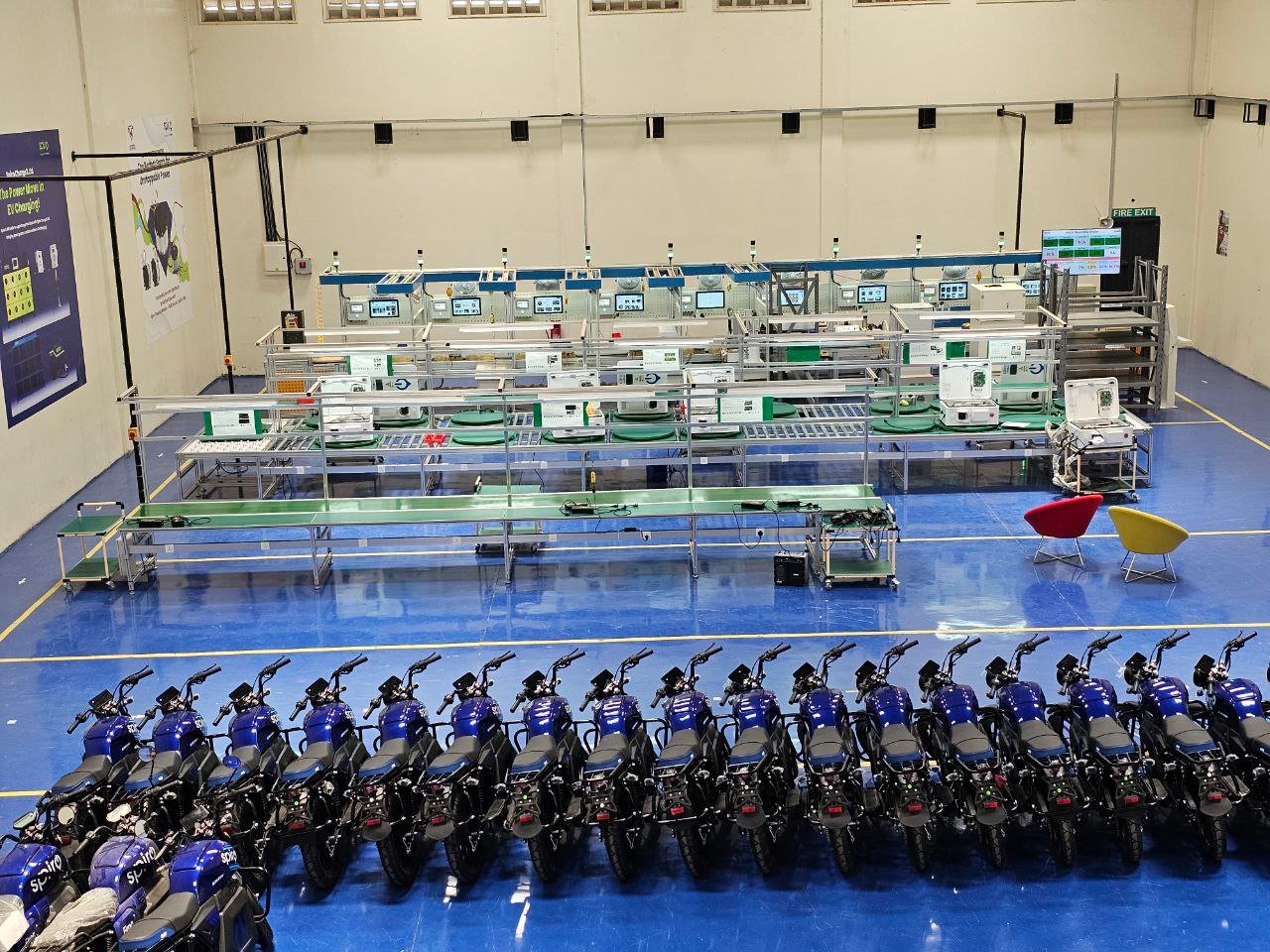
Spiro’s push for local production is anchored by its assembly plant along Mombasa Road in Nairobi. This facility is central to a broader strategy of transitioning from full imports to local assembly, aiming to build a supply chain that retains more economic value within the region. The company operates four such plants across Kenya, Rwanda, Uganda, and Nigeria, a regional network that reduces transport costs and stimulates local job creation.
A notable feature of the Nairobi operation is the composition of the workforce, with women making up more than 40% of Spiro’s manufacturing team, both direct and indirect. This represents a significant breakthrough in a sector historically dominated by men. Electric bike parts arrive as kits, and technicians inspect the components such as motor windings, bearings, and seals for waterproofing. The assembly process involves fitting the motor controller, wiring, battery modules, and the management system, followed by the frame, suspension, brakes, and display. The motor itself is manufactured locally. Each assembled bike undergoes bench and road testing before being delivered to the customer.
While local assembly leverages tax incentives and minimizes logistics costs, a key bottleneck remains the battery cell. Constituting 35 to 40% of the vehicle cost, the cell is entirely imported. Currently, only 30 to 40% of the materials used in assembly are sourced locally. This reliance on imported battery cells exposes the company to global price volatility and supply chain disruptions for its most expensive input component.
Technology and Circularity
Spiro employs proprietary IoT based platforms for real time tracking, smart diagnostics, and swap optimization, ensuring the safety and efficiency of its batteries in circulation. The company has a focus on battery management and circularity. Once batteries reach approximately 80% of their original capacity, rendering them unsuitable for high-demand mobility applications, they are repurposed for second-life uses. Spiro has also established a partnership with Ace Green Recycling to manage the safe recycling of end-of-life lithium-ion batteries and waste generated from manufacturing operations.
Product Offerings and Operational Scale
Spiro sells specific electric motorbike models tailored for the rigorous demands of commercial boda-boda operators. The flagship EKON 450M1 model features a powertrain with a nominal power of 4.5 $\text{kW}$ (peaking at 9 $\text{kW}$), a top speed of less than 85 $\text{km/h}$, and a range of 80 to 100 $\text{km}$ per battery. The older Commando model offered 6.5 $\text{kW}$ power and a top speed of 80 $\text{km/h}$, with a range of 40 $\text{km}$ per 2 $\text{kWh}$ battery. Both models feature robust suspension, LED headlights, and metallic storage compartments with built-in USB charging ports.
The scale of Spiro’s operation underscores its position as a market leader. Official statistics indicate that the company controls over 90% of all electric vehicles in Kenya, including bikes and cars, and 52% of the electric motorbike market specifically. It also controls about 21% of Kenya’s total motorcycle market, including petrol models.
The company has a significant fleet deployed across its markets. Recent operational reports indicate approximately 34,000 electric motorbikes are deployed across Kenya, Uganda, and Rwanda, with others spread across its West African markets. The internal growth plan, codenamed “Project Thunder,” aims for a target of 100,000 bikes.
To support commercial riders who frequently exceed 150 $\text{km}$ and sometimes reach 180 $\text{km}$ per day, Spiro maintains a high density of battery assets. The company claims to have deployed over 100,000 batteries and processed more than 23 million swaps. This high battery to bike ratio confirms a significant energy inventory redundancy, a massive upfront capital expenditure necessary to ensure sub-minute swap times and eliminate range anxiety for high-utilization commercial operators. The infrastructure consists of over 1,000 swap stations across its network, with approximately 200 concentrated in Kenya, primarily in the western part of the country.
Financial Backing and Rider Acquisition
Spiro’s business is capital intensive, requiring large upfront investments in bikes, batteries, and swap stations. The company has successfully raised over $180 million since 2022 from multiple financiers. Key backers include the Afreximbank, Société Générale, GuarantCo, and the Africa Transformation and Industrialisation Fund. For example, in 2023, the company secured $60 million in debt from Société Générale and GuarantCo for expansion in Kenya and Uganda. In 2024, an additional $50 million was raised from Afreximbank to support entry into Cameroon and Morocco, alongside scaling its automated swap network.
The reliance on development finance institutions provides access to patient capital and enhances credibility in climate finance circles, a necessity for a high-infrastructure business model.
While Spiro manages the asset risk associated with the battery, the company strategically outsources the retail credit risk for the physical vehicle. This is achieved through partnerships with vehicle asset financiers such as Kenya Commercial Bank (KCB), Mogo, and Watu Credit. This arrangement facilitates rider acquisition by offering financing options and making the EV accessible, even to those without traditional banking access, through mobile money payment systems.
In Kenya, the initial cash retail price for a Spiro EV motorcycle is around KES 295,000, roughly $2,290. This figure typically represents the overall loan cost over the full term, such as 24 to 30 months. This cost covers the principal amount, interest rates inherent in micro-asset financing, comprehensive insurance, and logbook transfer fees, all managed by the financing partner. Credit purchases require an initial down payment of KES 20,000. In a strategic market maneuver, the company launched the EKON electric bike in Rwanda at a significantly lower price of just $500, aimed at dominating the Kigali market ahead of a government mandate for electric public transport registrations.
Market Execution in Kenya
Kenya serves as Spiro’s primary base, hosting its headquarters and main assembly plant in Nairobi. Operations began in Mombasa before expanding into the greater Nairobi area, including Kiambu, Kajiado, and Machakos, and subsequently into Eldoret and Kisumu. The company currently runs more than 200 swap stations across Kenya, supported by asset financing deals with Watu Credit, KCB, and Mogo. The Nairobi head office features a command center where a team tracks live data on bike range, swap station status, and payment records, which helps the company collaborate effectively with asset financiers by providing visibility into customer behavior.
For the rider, the total cost is predictable and often lower than fueling a petrol bike. A trip of 80 to 100 $\text{km}$ on a Spiro bike costs about $2.24, which is the price of one battery swap. In comparison, a typical petrol bike covering 500 $\text{km}$ might spend approximately $15.60, making the Spiro option roughly 30 to 40% cheaper per kilometer. New riders, such as Kelvin, who collected a bike at the Nairobi plant, are financing their purchases through partners like Mogo with a deposit of KES 25,000 and daily installments of KES 450 over 18 months.